 National Vegetarian Day
Recently in the news was a story about Paul McCartney, ex-Beatle, urging the Prime Minister of India to declare January 12 as a national Vegetarian Day to celebrate a meat free lifestyle. As almost half of India’s 1.2 billion population is vegetarian, it seems like a good move.
It is reported he wrote, “Would you please think about declaring one day every year – perhaps January 12, which is the anniversary of PETA India’s founding, to celebrate vegetarianism and compassion towards animals? Such a declaration would save countless animals, reduce the environmental devastation caused by the meat industry and help participants clear their arteries and their consciences. It would be a celebration of life – all life.”
What interested me about this story was not that McCartney and his late wife Linda had been long-time animal rights activists since the 1970’s or the description of how a fishing trip made him vegetarian, “Many years ago, I was fishing, and as I was reeling in the poor fish, I realized, I am killing him – all for the passing pleasure it brings me. Something inside me clicked. I realized as I watched him fight for breath that his life was as important to him as mine is to me.” What really interested me was the comments posted under the article. It was compelling to read people’s remarks and the passions that this topic evoked. Carnivores and non- carnivores alike can become so enraged with each other when their beliefs are challenged. Nobody likes to be wrong as it seems to threaten our very sense of self.
I think the problem in this debate is a lack of understanding about why someone chooses to abstain from animal consumption. Some people are vegetarian for health, environmental and financial reasons. Probably most abstain from eating any flesh products is due to ethical reasons. It is a moral issue for some, just like slavery and child labour once were. At one time in North America slavery was an acceptable practice. People who practiced “love thy neighbour” seemed able to exempt African slaves from this belief. Children were once used as laborers up until the beginning of the 20th century until legislation enacted laws against the hiring of children.
Societies collective morality is always evolving and changing. People are continually questioning how things work and if practices are acceptable to them or not. Our opinions, beliefs and values as a society have changed over the years and continue to do so.
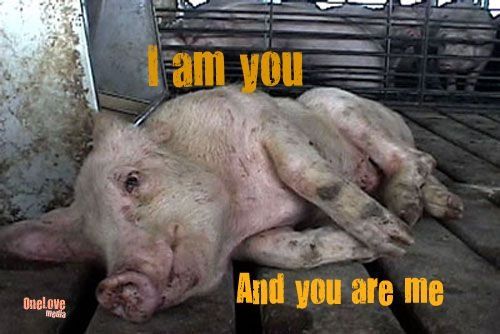
Animal rights is a moral ethical issue and that is why it raises so much intense emotions. It is more than just a personal food preference. McCartney’s quote “if slaughterhouses had glass walls, everyone would be a vegetarian,” raises awareness about the cruel treatment of farm animals. If people really knew how farm animals are treated, they might identify more with the nicely wrapped, frozen cut of meat. Mahatma Gandhi, spoke, “The greatness of a nation and its moral progress can be judged by the way its animals are treated.” He asks us to look at how we are treating the most vulnerable in society. If we really want violence to end, we have to consider all acts of violence as unacceptable and factory farming is not a natural part of the food chain. If you are brave enough, go to peta.org and watch a video to see for yourself.
This debate interests me because I have been a vegetarian/vegan for twenty years now. There came a time in my life when I realized if I can’t go out and murder an animal for my food, I wasn’t going to eat it. It became a black and white issue for me – either I can or can’t. Maybe the pendulum will swing as more people consider animal suffering as important as other human rights issues. No one has to be perfect, even small changes can make a difference. After all these great thinkers: Einstein, Tolstoy, and Leonardo Da Vinci chose vegetarianism.

 I have a very sweet, six year old friend whom I recently visited with in his home. He proudly showed me the knight’s shield that he had made and I noticed a heart glued on to the outside of it. When I asked him about it, he carefully explained to me that as a knight he was not really a fighting knight but a “heartening” knight. I love that he made up a word and so I asked him to explain “heartening” to me. He seemed to have given this a lot of thought and was very deliberate in his explanation. He told me that he had a heart on his shield because he was a knight that was not wanting to fight but rather wanting to use his heart instead. A brilliant child I thought to myself. I assumed that someone must have explained the virtues of being a knight to him and this had appealed to his developing personal values.



 onelovemedia